
ABOUT COLD GALVANIZING TECHNOLOGY
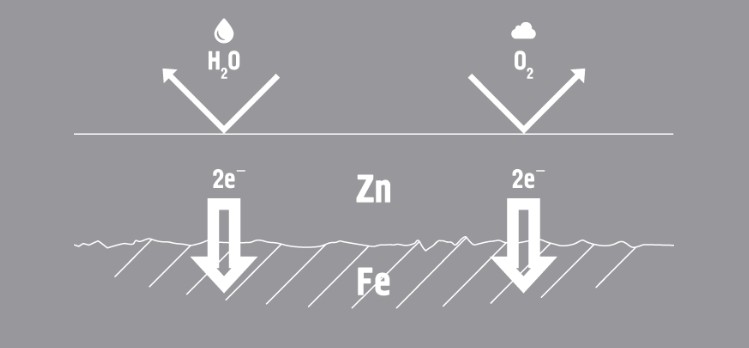
Corrosion is thermodynamically inevitable, but thermodynamics itself suggests the most effective method of combating corrosion: cathodic sacrificial protection. With this method of protection, the iron breakdown reaction becomes thermodynamically impossible, and therefore corrosion stops completely! Other methods are less effective: inhibitors only slow the process, while barrier coatings are prone to localized and subfilm corrosion.
Cathodic sacrificial protection can be provided by either an external current or by the current generated by a galvanic cell, which occurs when iron comes into contact with certain active metals, particularly zinc. Galvanizing can be performed using various methods: hot galvanizing, galvanic galvanization, thermal diffusion, etc. However, a number of limitations for each method prevent all objects from being protected. In this situation, cold galvanizing comes to the rescue. What is it?
COLD GALVANIZING
"Cold" galvanizing is the application of a special zinc composition containing high-purity active zinc, polymer binders, and volatile agents to a prepared surface using a method typical for paint and varnish coatings. It should be understood that the presence of zinc powder in an organic solvent-based varnish does not make this mixture "cold" galvanizing. What's the difference? First, the composition must be applied as a standalone coating (otherwise, it is not galvanizing, but a coating system). Second, it must have the protective effect of other galvanizing methods.
Zinc coatings, regardless of the application method, have a protective effect only as long as they are actively dissolved by the external corrosive environment. If zinc loses its ability to actively dissolve, its cathodic protective effect is reduced or even completely eliminated! The ability of the polymer film to block the dissolution of zinc during the curing of certain types of binders makes protective protection impossible in such coatings (in particular: polyurethane, epoxy, acrylic).
The vast majority of zinc-filled materials available on the Ukrainian market are used as primers in primer-finish or primer-intermediate-finish coating systems. These compounds do not provide protective coating, and therefore are not considered "cold" galvanizing, but serve only as barrier coatings.

The TEPLOANTIKORZASHCHITA Research and Production Center has developed and produces ZINTEC®. Its zinc coating offers the protective properties of other galvanizing methods and can be used as a stand-alone coating without the need for a topcoat.
ZINTEC® is a thin-film zinc coating that effectively protects ferrous metals from corrosion, offering high protective properties and excellent adhesion to metal surfaces.
ZINTEC® cold galvanizing compound is designed for anti-corrosion protection of the exterior and interior surfaces of industrial equipment and metal structures.
ZINTEC®-based coatings provide both active (cathodic) and passive (barrier) corrosion protection.
ZINTEC® cold galvanizing compound can be used in industries such as industrial and civil construction, transportation, oil and gas, energy, railway and subway facilities, ports and hydraulic structures, and automotive transport.
In 2012, 2013, and 2014, accelerated corrosion tests were conducted to assess artificial aging and durability. Notched coatings based on the ZINTEC® compound were tested for resistance to salt fog (1,440 hours), continuous moisture condensation (720 hours), and sulfur dioxide (720 hours) under conditions of corrosion category C5-1. Based on the results, the Donbas Center for Technological Safety of V.N. Shimanovsky Ukrinstalkon LLC (DonCTS) concluded that the ZINTEC® coating on carbon steel retains its protective properties in aquatic environments (sea and fresh water) and atmospheric conditions for more than 15 years, and this period is not the maximum, i.e., it is equal to or superior to hot-dip galvanized coatings.
THE UNDISPUTED ADVANTAGES OF ZINTEC®
It reliably provides long-term cathodic protection for ferrous metals. It is easy to use (apply using any paint coating method: brush, roller, spray, etc.), dries quickly (30 minutes), can be applied at sub-zero temperatures (-35°C) and in high humidity, is easy to repair, and has a long service life. It is a single-component product.
All you need to do is prepare the surface, mix thoroughly with a mixer, and apply using any convenient method!
Unfortunately, the availability of low-quality zinc-containing materials on the market, mistakenly called "cold" galvanizing, undermines the very idea of this method of anti-corrosion protection using special protective compounds. The presence of counterfeit products on the market also plays a negative role.
Consumers simply don't believe that such protection is possible!